FG FINE ART LTD
Pseudo Pierfrancesco Fiorentino
Florence, 1470 - 1490 c.
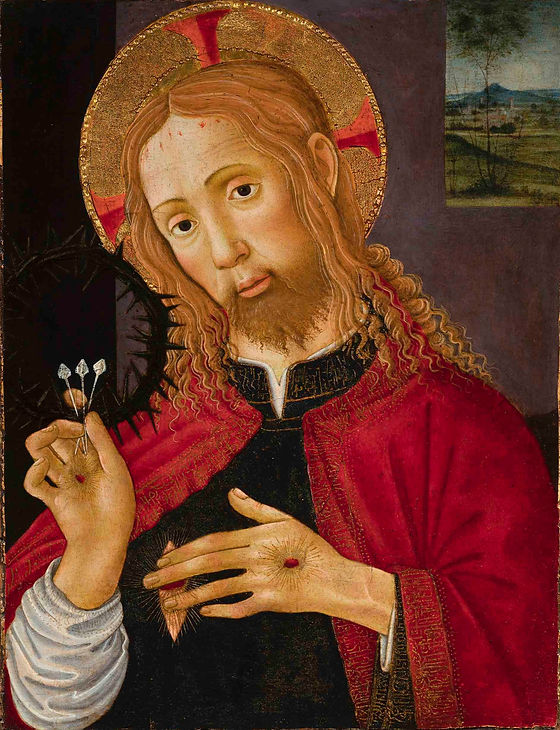
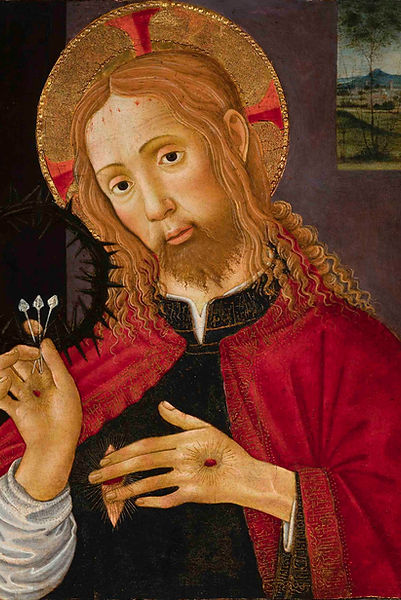
As Andrea De Marchi highlighted on the occasion of his publication of the work in 2022, there can be no doubt about the reference to Pseudo-Pier Francesco Fiorentino in this unusual panel depicting a living Christ displaying his wounds, nails, and crown of thorns. Unmistakable is the inlaid veneer of nuanced, almost gelatinous flesh punctuated by slight redness, in turn set like precious stones amidst insistent golden guilloche patterns, ranging from the rays that make the lacquer drops of the wounds bloom, to the braids inscribed with pseudo-Islamic inscriptions, from the speckles to the grain of the halo, to the chalky tactile relief of the crown of thorns.
Vir Dolorum
1480 c.
Tempera on panel, 41 x 31.5 cm
PROVENANCE
Florence, Enrico Frascione, 2022
Private Collection
BIBLIOGRAPHY
A. De Marchi, Squisiti arcaismi. La “pittura senza tempo” dello Pseudo Pier Francesco Fiorentino e un Cristo di dolori filippinesco, in Pseudo Pier Francesco Fiorentino Cristo di dolori, Florence 2022, pp. 3-10
D. Civettini, ‘Stachanovista’ e ‘pasticheur della pittura fiorentina: lo ‘Pseudo Pier Francesco Fiorentino’, in Pseudo Pier Francesco Fiorentino Cristo di dolori, Florence 2022, pp. 13-14
C. Daly, Lista di opere attribuibili allo ‘Pseudo Pier Francesco Fiorentino’ e bottega, in Pseudo Pier Francesco Fiorentino Cristo di dolori, Florence 2022, p. 43

Compared to those paintings, which are generally of modest quality and therefore difficult to attribute, this one demonstrates with rare clarity the authorship of the ‘Pseudo’, beginning with the vague yet accomplished expression of Christ, tenderly depicted with an extremely detailed application that, while limited to a few shades of colour, brings to life with rosy touches the eyelids, nostrils, cheeks, and sighing lips. This sensitivity is matched by the exquisite pictorial material of the carmine red of the cloak and the stigmata, set in the hands like well-ground rubies, the metallic refractions of light, as well as the characteristic gold applications, in leaf for the cruciform halo, in mission along the hems of the garments, from the white crucified camisole to the high-collared blouse, to the Sanrocchino vermilion, tied at the chest with two golden threads.
The painting discussed here dates from a rather late period, as it appears to be based on a lost prototype by Filippino Lippi dating to the early 1480s. Compared to the group of works based on models by Pesellino and Fra Filippo Lippi, it therefore harks back to a later period and helps reconstruct the continuity of a workshop that between the 1470s and 1480s radically reformed its repertoire, updating itself with the most fashionable painters, Filippino first and foremost, while maintaining the solidity of a traditional and unalterable formal signature. It is a truly exquisite painting, which at the same time demonstrates how this workshop did not simply and mechanically revert to the late production that Everett Fahy had already begun to identify and which is carefully traced in the list produced by his student Christopher Daly, but rather was capable of qualitative peaks and therefore of astutely differentiating between standard production and more demanding commissions. The not lacking of these is suggested by what has all the appearance of being the depiction of Lorenzo il Magnifico, in an unusually austere and even shy dress, in the arched altarpiece with the Nativity of Christ and various saints in the Museuo of Palazzo Venezia. Furthermore, as suggested by Andrea Staderini, we can identify in the Saint Jerome and a Monk (c. 1460) by Pseudo Pier Francesco Fiorentino, now at the Accademia Carrara in Bergamo, the painting cited in the inventory of the Medici palace in Via Larga, in 1492, upon Lorenzo’s death, bizarrely attributed cumulatively to Fra Filippo and Pesellino, and deriving from a famous painting by Fra Filippo Lippi now in Altenburg, at the Lindenau-Museum.
The noblest formulation of this iconographic invention is currently that of the Museum of Art in Birmingham, Alabama, a work traditionally attributed to Jacopo del Sellajo, but which Everett Fahy instead attributed to Filippino Lippi. |This orientation is in fact substantially correct, morphologically speaking, if the painting is considered a faithful derivation from a lost original by a more rigid follower. Christ displays only the crown of thorns with his right hand, and his forehead is not bordered by wounds. In the foreground, on a parapet, are the sponge soaked in vinegar, three twisted nails, and the whip of the flagellation; his half-length figure stands out in a grey room, opened by two windows, on the left side, foreshortened and without more than the jamb being visible, and in the background, with a glimpse of a typically Filippino landscape. There are two other versions, almost identical in iconography and setting (only the parapet with the attributes of the Passion is missing), one of which seems to refer to Filippino’s more mature style, from the 1490s. In all three, Christ wears a red robe and a blue cloak over it. Pseudo-Pier Francesco Fiorentino, however, inverted the garments, placing a red chlamys over them, in allusion to the purple and regal one imposed on Christ in mockery before Pilate. Some later versions, also from the school of Sellajo, but already belonging to his son Archangel, also feature nails and a sponge on the parapet, a forehead rimmed with drops of blood, where, however, the wound on his side is no longer visible, and Christ, in his right hand, holds the tip of the spear that caused it, in place of the crown of thorns. Christopher Daly then points out a curious painting attributed by Everett Fahy to Tommaso di Piero Trombetto from Prato, depicting the Christ of Sorrows between Saint Francis and a holy martyr deacon, which derives from our Christ, although adding on the forehead a heavy crown of thorns-rings wrapped around itself and proposing a more Botticellian smooth hair, and a more saccharine version by Bartolomeo di Giovanni.
A full fact sheet is available on request.
