FG FINE ART LTD
Master of Fossa
Active in Spoleto and in Abruzzo between the third and the fifth decades of XIV century
This opistographic processional cross can be reconducted back to the workshop of the Maestro di Fossa, the major artist of the fourteenth-century Spoleto school, rediscovered through the seminal studies of Roberto Longhi, who was widely active in a vast area extending from the Nerina Valley to the innermost valleys of Abruzzo


on the front with
Master of the Silver Crucifix
Active in Nerina Valley and in Abruzzo between the fifth and sixth decades of XIV century
on the back with
Master of the Calvaries
active in Spoleto in the second half of the XIV of the century
Opistographic processional cross
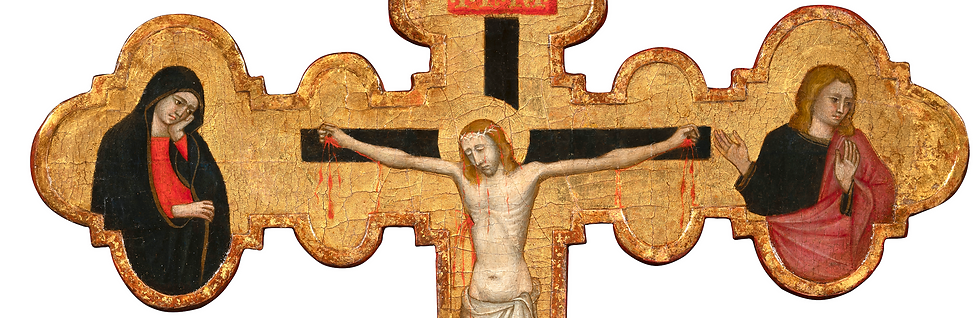
On the front: Christ Crucified between the grieving Virgin and Saint John, Christ Risen
On the back: Christ Crucified between the grieving Virgin and Saint John, Saint Michael and the holy apostle (Saint Andrew?)
Tempera and gold on panel, cm 44 x 38,5 x 2 maximum measures
INSCRIPTION
“ego / sum / vita / vie (sic) // v(er)itas / qui /
(…) [sequitur me non ambulat in tenebris]

At the moment, we know of another processional cross of his, preserved in the Museo Civico of Rieti, coming from San Francesco a Posta (between Antrodoco and Amatrice), of similar dimensions, only higher, but also serving as a relic, of Minorite origin and with a shape with crescent-shaped and polylobed ends, of completely different Adriatic origin.
This one, however, features large quatrefoils at the ends, from Tuscan typologies.
The square anatomy, softened by the tapered facial features and sensitive shading, in both cases accentuates the painful rendering with copious spurts of blood flowing from the prominent crown of thorns, dripping onto the gold in several splashes from the hands, but also along the forearm and elbow, spurting from the ribs and dripping down the body until it soaks the loincloth. These are the same characteristics found in the still intact and impressive polychromes by the Master of the Trevi Cross, aka Master of the Cross of Visso, with whom the Master of Fossa trained in the early 1320s.
We can define the front side as the one featuring the Risen and Blessing Christ at the top, with the book open on some well-known verses from the Gospel of John, the Sorrowful Virgin pointing to Christ with her right hand in a gesture of intercession, and Saint John the Evangelist clenching his fists downward in contrition. At the bottom is the Cross stuck in Golgotha, a clay rock like those in the painter’s polyptych from San Francesco a Montefalco (now in the Vatican Museums, dated 1336), with an unusual oblique cut. The back side, in addition to the two mourners, includes, on the vertical axis at the top, a despairing Saint Michael, clasping his hands, and at the bottom an elderly, bearded apostle saint, holding a book, perhaps Saint Andrew, but more damaged.
The unmistakable features of the Master of Fossa emerge clearly in the Risen Christ and in the two faces of Christ Crucified, especially in the one on the back, which is better preserved and appears to be his own work, given its shelled almond shape, sharp features, and light shadows, compared here is the fresco in the Barnabite convent in Campello sul Clitunno, dated 1342.
The face of the risen Christ can also be compared with that of Saint Michael the Archangel painted in the crypt of San Ponziano in Spoleto, one of the painter’s most intense and luminous masterpieces, dating back to a relatively early period, around 1330.
However, if one carefully analyses the work, a notable variations in the painting on the two sides can be found, in both cases with characteristics not entirely typical of the autograph paintings of the Master of Fossa, so much so as to raise the suspicion that it was indeed carried out in his workshop, but with the participation of two different students, who can perhaps be better focused and traced in their independent entourage.
Of higher quality, the front features two mourners with broad and solemn gestures. The Virgin has tapered hands, reminiscent of Simone Martini in Assisi. The hem of her cloak is embellished with a gold thread, of a lower gold, to the point that at first it might appear to be half gold, but which, as documented by restorer Loredana Gallo, is actually gold leaf specially glazed with an antique varnish.
Saint John’s cloak features puffy folds carved with alveoli, typical of the more complex sculptures of the Master of Fossa, but the broader planes of the faces, the smaller and more shaded eye sockets, and the pathetic tone of their reclining posture are in harmony with two other paintings on panel, in which Lorenzo Sbaraglio has acutely recognized the beginnings of another great painter active between Spoleto and Abruzzo, the Master of the Silver Crucifix, one being the centre of an altarpiece with the Madonna and Child between Saint Francis and Saint Louis of Toulouse, from the collection of Andreas Pittas in London and the Cross from the parish church of Ussita, discovered years ago by Matteo Mazzalupi and attributed by him to the Master of Fossa.
As Sbaraglio rightly writes, to differentiate these works from those typical of the Master of Fossa, they are “distinguished by a luxurious and goldsmith-like tone in its acid and enamelled colors, by the refinement of its chromatic juxtapositions […] as well as by a modeling that is less apparent and more fused than that of the Master of Fossa, and by a certain taste for deformation.” All elements typical of the Master of the Silver Crucifix, a still elusive anonymous artist who particularly fascinated Roberto Longhi, who coined this name. Todini explained the anomalies of the Pittas panel as an early work by the Master of Fossa, in the 1920s, while more convincingly Sbaraglio attributed the triptych, formerly Böhler and later Alana, to his early work. Placed among the juvenilia of the Master of the Silver Crucifix, the Pittas Madonna thus dates back to a later period, around 1340, corresponding to the full maturity of the Master of Fossa.A certain squareness of the draperies, even in the two mourning Saint John, as well as in the Saint Michael on the back, are reflected in this latter work. The cross in question therefore allows us to go further back, within the same workshop where the Master of the Silver Crucifix trained, to around 1340.
A full fact sheet is available on request.
