FG FINE ART LTD
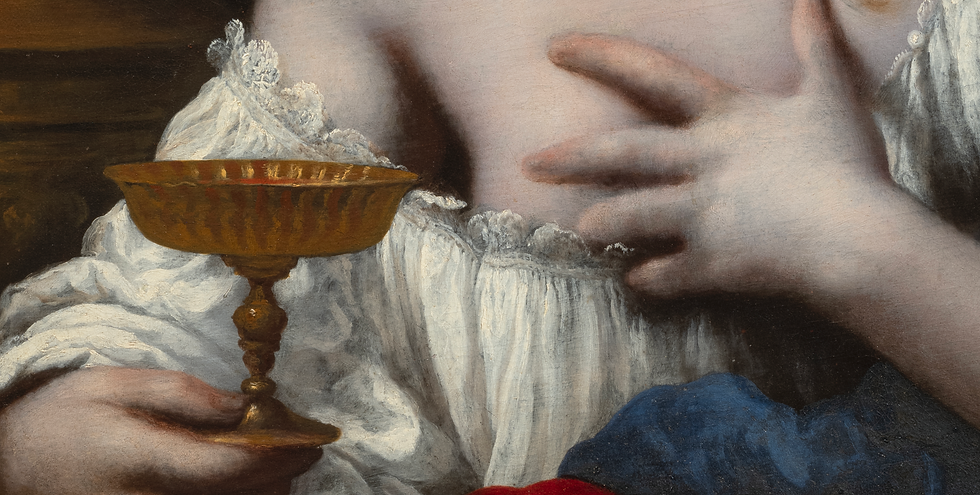
Felice Ficherelli
San Gimignano, 1605 - Florence, 1660
This refined work by Felice Ficherelli (1603–1660) has a distinguished British provenance. It was probably acquired by King George III in 1762 through Joseph Smith, British Consul in Venice, as part of the celebrated Smith collection, and was recorded at Kew Palace in 1805. It later entered the collection of John Hamilton in Dublin, before appearing on the London art market through Christie’s and Colnaghi in the late twentieth century.

Sophonisba and the poisoned cup
Oil on canvas, 73.1 x 60.4 cm
Provenance
Probably acquired in 1762 by George III from Joseph Smith, British Consul in Venice, recorded at Kew Palace in 1805 (no 281) as Francesco Furini
Dublin, 14 Merrion Square, John Hamilton (1809 - 1875)
London, Christie’s, 7th July, 1978, lot 117 as Francesco Furini
London, Colnaghi, 1979
London, Christie’s, 28 May 1982, lot 81 as Francesco Furini
Florence, private collection
Exhibitions
London, Royal Academy, Painting in Florence 1600-1700, 20 January - 18 February 1979
Cambridge, Fitzwilliam Museum, Painting in Florence 1600-1700, 27 February - 28 March, 1979
Bibliography
L. Cust, Notes on Pictures in the Royal Collections-XXV: The Paintings Bought for George III in Italy, Consul Smith, and Antonio Canale - I, in “The Burlington Magazine for Connoisseurs”, Jun., 1913, Vol. 23, No. 123, p. 154
C. McCorquodale, Painting in Florence 1600-1700, London 1979, p. 68
C. McCorquodale, A dark century, the English taste for Tuscan Painting, in “The Connoisseur”, 200, March 1979, pp. 173, 174, 176
C. Neve, Piety and Prudence. Painting in Florence 1600-1700, in “Country Life”, February 8, 1979, p. 340
G. Cantelli, Repertorio della pittura fiorentina del Seicento. Aggiornamento, Pontedera 2009, p. 100
G. Cantelli, Repertorio della pittura fiorentina del Seicento. Aggiornamento. Tavole, Pontedera 2009, p. 32
G. Cantelli, Furini e i furiniani, Pontedera 2010, p. 53 fig. 47

This canvas by Felice Ficherelli - nicknamed “Il Riposo” (The Quiet One) due to his placid temperament - depicts Sophonisba at the climactic moment of her tragic fate, as she prepares to drink the poison sent to her by her husband, the Numidian King Masinissa, to spare her the humiliation of Roman captivity.
A pupil of Jacopo da Empoli, Ficherelli was closely attuned to the artistic world of Francesco Furini; our primary source of information on him is Baldinucci, who records that he enjoyed the patronage of Alberto d’Ottavio de Bardi (of the Counts of Vernio), then serving as Master of the Horse to Cardinal Carlo de’ Medici. Born in 1605 - a contemporary of Furini - he was known in Florence not only for his artistic skill but also for his eccentric habits. Despite earning a handsome income, he was content to subsist on simple bread-and-egg soup and dressed in an unbelievably shabby manner; whenever friends compelled him to smarten up a little, he did so with deep reluctance, as it went against his very nature.
There are many paintings of Magdalens or scantily clad female saints that were once attributed to Furini but were reassigned to this artist’s catalogue by Cantelli - who also published the Sophonisba discussed here. Indeed, Riposo’s reliance on Furini’s soft, sensual style is acknowledged even by a contemporary, Baldinucci; he informs us that, once free from the patronage of Bardi - for whom he had painted for some time - the artist began to receive a great number of commissions for paintings intended for reception rooms and private chambers. This was because he had already developed a charming style of great tenderness, having refused to work without a live model and having devoted himself to studying Furini’s unique approach to colouring4.
For Ficherelli, too, Furini was the most modern artist to emulate - certainly the one whose work best aligned with the new emotional sensibilities of the literary and musical culture in Florence at the time, as well as with the aesthetic of “psychological Baroque” that Furini himself pioneered. Cultured and modern, he found the key to expressing the sensual languor - not only of his own generation but also of much Florentine painting to come, right up to the early eighteenth century - in the sublimation of extraordinary beauty. Riposo’s emotional affinity for Furini is also openly evident in his choice of subjects, a fact that led to attributional confusion - though this has now been largely resolved. In reality, Riposo differs from Furini through a dewier, fluid paint texture and, often, through figure types that lack the subtle, refined sensuality characteristic of Furini. While his Magdalens resemble Furini’s, they display a distinctive, melancholic despondency, achieving a dramatic intensity and theatrical expressiveness - as seen, for instance, in the Saint Mary Magdalene at the National Gallery of Ireland in Dublin.
Regarding depictions of sacred figures, the Saint Agatha at the Musée Magnin in Dijon serves as a key reference for the artist’s female typology: an idealized face, fair complexion, a poignant expression, and a sensuality tempered by a devotional quality. A similar and even closer connection exists between our Sophonisba and the Cleopatrain the National Gallery of Slovenia - also a half-length portrait characterized by soft, luminous modelling - as well as the Saint Catherine of Alexandria, formerly in the Piero Bigongiari collection and now held by the Fondazione della Cassa di Risparmio di Pistoia e Pescia.
Similar stylistic traits appear in our Sophonisba - with her melancholic awareness of destiny and unfolding events - and in the Judith and Holofernes. The latter, formerly in the collection of Marchese Gian Francesco Giaquili Ferrini and later in a private collection (offered by Pandolfini in Florence in 2014), provides a further point of comparison for the construction of a female figure who is simultaneously seductive and tragic. In that instance, too, scholars have highlighted Ficherelli’s mature phase and his predilection for subjects of intense drama. In the Sophonisba, however, the violence is entirely internalized, and the gesture becomes more measured - almost liturgical.
The painting’s provenance is of particular interest, as it helps document the reception of seventeenth-century Florentine painting in Britain. According to the provenance cited by McCorquodale in the catalogue for the exhibition held at the Royal Academy in London and the Fitzwilliam Museum in Oxford, the painting was most likely purchased in 1762 by King George III (1738 - 1820) through Joseph Smith (1682 - 1770), the British consul in Venice and a prominent intermediary and collector. Indeed, by 1805, the work is recorded in the inventories of the royal residence at Kew Palace, Richmond, under number 281. While it is impossible to determine with certainty exactly when it left the royal collections, the only established fact is that in 1806 George III designated Kew - including the house and its contents - for Queen Charlotte.
The relationship between George III and Joseph Smith must be viewed within the context of the collecting activities initiated by the young monarch during the early years of his reign. Smith - a merchant and banker active in Venice since the early eighteenth century and British Consul from 1744 - had assembled one of the city’s most significant private collections while simultaneously playing a pivotal role as an intermediary between Venetian artists and British collectors. He was a friend, patron, and agent to key figures such as Canaletto, Rosalba Carriera, and Francesco Zuccarelli. In 1762, partly due to financial difficulties incurred during the War of the Austrian Succession and the Seven Years’ War, Smith was compelled to sell his collection. George III purchased a vast portion of it for approximately £20,000; the acquisition comprised around five hundred paintings - roughly two-thirds of which were by Italian artists - alongside an exceptional array of drawings and other works. The transaction was managed on the King’s behalf by Richard Dalton, the Crown’s librarian and art agent, who travelled to Venice to oversee the packing and transport of the collection. The Smith acquisition thus marked a foundational moment in George III’s collecting history, explaining the simultaneous entry into the Royal Collection of a substantial group of Italian - and specifically Venetian - paintings, as well as the most significant concentration of works by Canaletto currently held in the royal collection. Subsequently, the work passed to Dublin, entering the collection of John Hamilton (1809–1875) - a surgeon and president of the Royal College of Surgeons in Ireland who lived at 14 Merrion Square. Its later provenance is documented through the London art market: Christie’s, 7 July 1978, lot 117; Colnaghi, London, in 1979; and subsequently Christie’s, London, 28 May 1982, lot 81.
A full fact sheet is available on request.
